
Elf Bar Vape Explosion Amputation Case Triggers Insurance Lawsuit
Elf Bar Vape Explosion Amputation Case Triggers Insurance Lawsuit
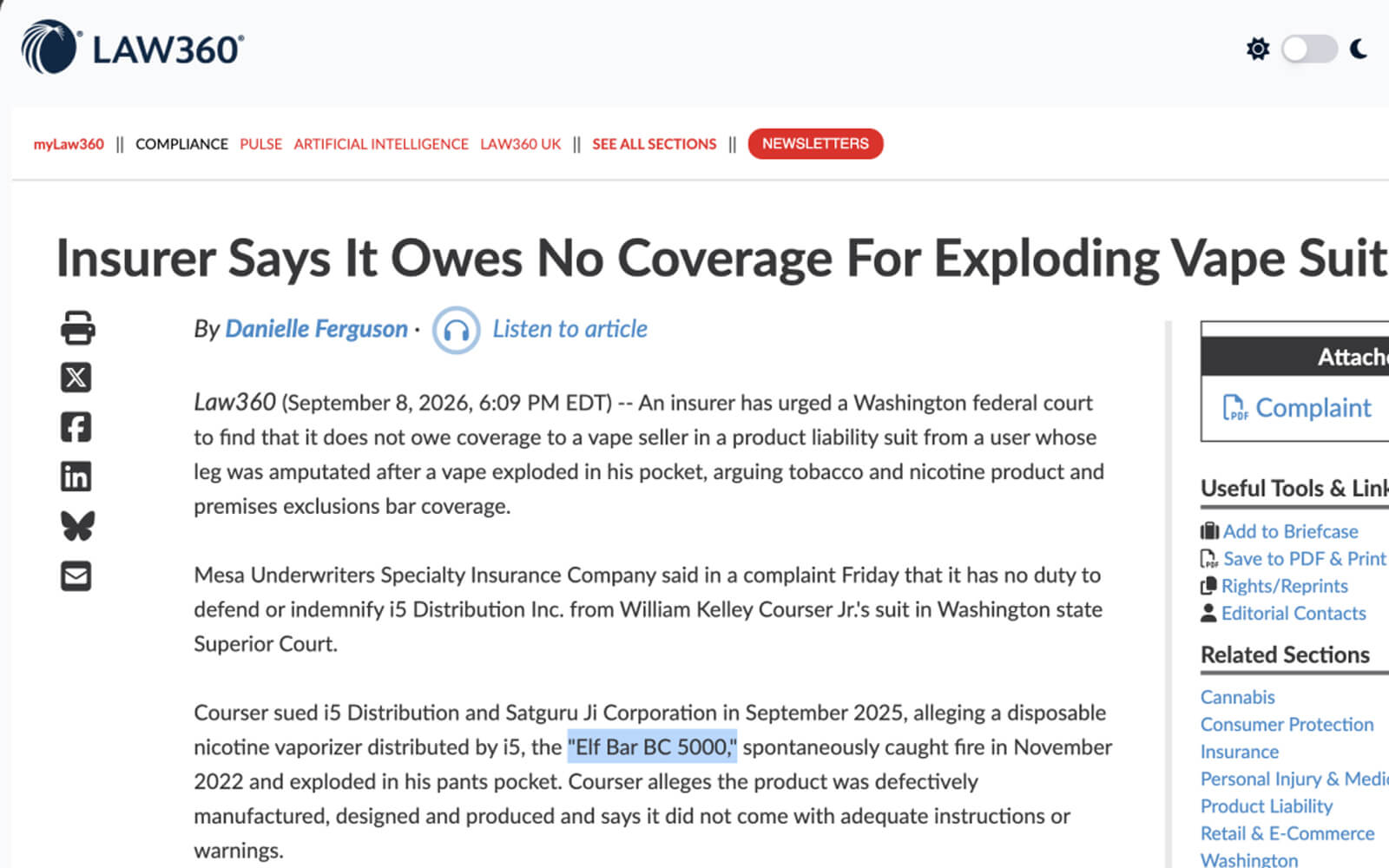
According to Law360 report on September 8th. Mesa Underwriters Specialty Insurance Company (MUSIC), an American insurance company, has filed a lawsuit in federal court in Washington state, requesting confirmation that it is not obligated to defend or compensate for the vape distributor i5 Distribution in a product liability case. The plaintiff claims that an Elf Bar BC5000 disposable vape caught fire and exploded in their pocket, causing severe burns and resulting in the amputation of their left knee. MUSIC cites the exclusion clauses for tobacco, nicotine, and nicotine replacement products in the policy, as well as the limitation clauses for business premises. The court has not yet made a ruling on this insurance coverage dispute.
Elf Bar Vape Explosion Amputation Case Triggers Insurance Lawsuit Core Overview
- MUSIC requests the court to confirm that it is not obligated to defend or compensate i5 Distribution for any related product liability litigation.
- The plaintiff in the original product liability case claimed that the Elf Bar BC5000 caught fire and exploded in its pants pocket in November 2022, causing injuries that ultimately led to the amputation of its left knee.
- MUSIC stated that the policy excludes personal injury caused by tobacco, nicotine, or nicotine replacement products, and lists electronic atomizers as an example of related products.
- MUSIC is currently defending i5 while retaining its rights, and the federal court has not yet decided whether the exclusion clause applies to this claim.
Mesa Underwriters Specialty Insurance Company (MUSIC), an American insurance company, has filed a confirmation lawsuit with the Federal District Court for the Western District of Washington, requesting the court to rule that it is not obligated to defend or compensate i5 Distribution Inc., a vape distributor, in a product liability lawsuit involving Elf Bar BC5000.
The plaintiff in the product liability case, William Kelley Courser Jr., claimed that an Elf Bar BC5000 disposable vape distributed by i5 caught fire and exploded in his pocket, causing severe burns and ultimately resulting in the amputation of his left knee.
The cause of the explosion, whether there are defects in the product, and the causal relationship of the injury are currently all claims in Courser’s lawsuit and have not been confirmed by the court’s substantive judgment.
The plaintiff claims that Elf Bar BC5000 caught fire and exploded inside the pants pocket
Courser sued i5 Distribution and Satguru Ji Corporation in the Washington State Superior Court in September 2025.
According to its lawsuit claims, the Elf Bar BC5000 in question self initiated a fire and exploded in its pants pocket in November 2022, causing severe burns to its legs, torso, and some arms. Courser stated that his left leg subsequently had to be amputated above the knee.
Courser accuses the involved product of manufacturing, design, and production defects, and claims that the product did not provide sufficient usage instructions or risk warnings.
These claims have not yet been confirmed by the court. Law360’s report also did not provide further information on the specific taste, manufacturer, or cause of the explosion of the products involved.
MUSIC requests court confirmation that there is no need to assume defense or compensation obligations
MUSIC has issued a commercial comprehensive liability insurance to i5 Distribution, covering the period from June 1, 2022 to June 1, 2023, and covering the time of the alleged accident.
According to MUSIC’s lawsuit submitted to the federal court, the company is currently defending i5 against related product liability lawsuits while retaining its rights. This means that the insurance company temporarily provides legal defenses for policyholders, but reserves the right to claim that related claims are not covered by insurance coverage in the future.
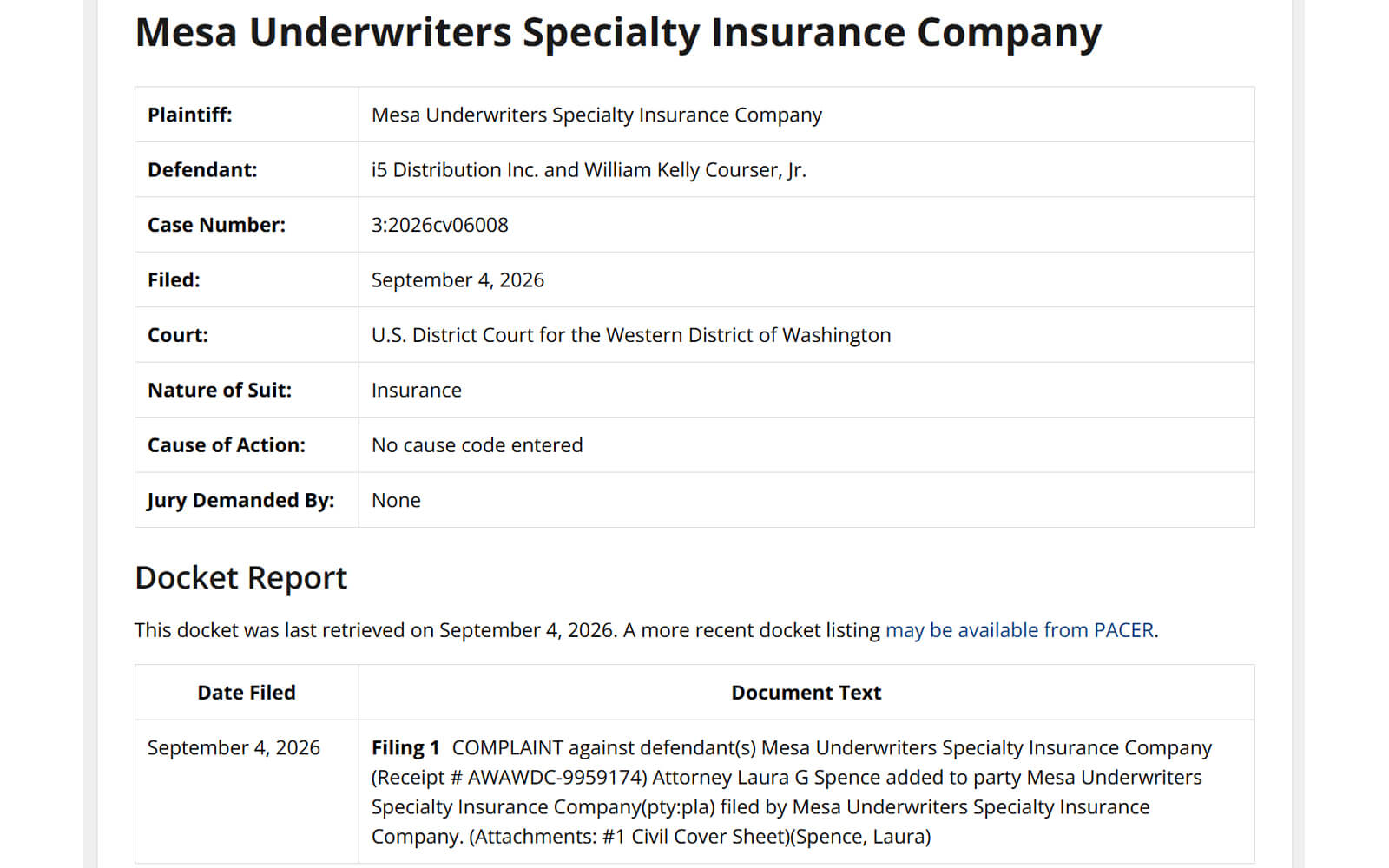
At the same time, MUSIC filed a separate lawsuit to confirm the judgment, requesting the court to rule that it no longer needs to continue to assume defense or compensation obligations for i5, nor does it need to pay the judgment compensation that Courser may have obtained in the original product liability lawsuit.
The federal case is Mesa Underwriters Specialty Insurance Company v. I5 Distribution Inc. et al., case number 3:26-cv-06008.
Law360 also stated that according to i5’s social media information, the company has ceased operations in 2025. The report did not describe the cessation of business as bankruptcy, nor did it explain how this situation would affect insurance litigation.
The policy includes exclusion clauses for tobacco and nicotine products
One of the main grounds for refusal of coverage proposed by MUSIC is the exclusion clause for tobacco, nicotine, or nicotine replacement products in the i5 policy.
According to MUSIC’s lawsuit, the additional clause states that the policy does not apply to personal injury, property damage, and personal or advertising injury resulting from the use, exposure, presence, or contact with tobacco, nicotine, or nicotine replacement products. The terms also list electronic vaporizers as examples of excluded products.
MUSIC argues that Courser’s claim of harm stems from disposable nicotine electronic nebulization products and therefore falls within the scope of this exclusion clause.
This is the insurance company’s interpretation of the policy terms and litigation claims. The federal court has not yet ruled whether this provision is sufficient to exempt MUSIC from its defense or compensation obligations in this case.
Business premises restrictions constitute another basis for refusal of underwriting
MUSIC also cited the additional clause on business premises restrictions in the policy.
According to the insurance company’s claim, this clause stipulates that personal injury or property damage is only covered by insurance when it occurs at the business premises listed in the policy.
MUSIC stated that the explosion described by Courser did not occur at the location listed in the i5 policy, therefore the related claims are also subject to the limitations of the business premises clause.
This constitutes another refusal of underwriting basis proposed by MUSIC. However, the location of the accident and the specific application of this clause to related claims still need to be reviewed by the court.
MUSIC has cited similar clauses in another vape insurance case
MUSIC has previously cited similar policy terms in other vape injury insurance disputes.
In August 2025, the Oregon Federal Court ruled in absentia against the injured claimant in the case of Mesa Underwriters Specialty Insurance Company v. Midway Vishions, confirming that MUSIC is not liable to pay compensation arising from the original product liability lawsuit.
The policy in this case includes exclusion clauses related to devices used for ingesting nicotine or marijuana, including electronic atomizers, as well as restrictions on business premises. The court held that the relevant injury occurred at the claimant’s residence and was caused by an electronic atomizer, which is not covered by the policy.
However, the procedural background of this case has significant differences. The policyholder Midway Vishions has voluntarily withdrawn from the confirmation judgment lawsuit by MUSIC and has not opposed the insurance company’s underwriting position; The court made a default judgment against the injured claimant.
Therefore, this ruling was not made after a fully participatory adversarial trial, and its facts, procedural status, and policy text are not entirely identical to the i5 case, which cannot directly determine the outcome of the Washington state case.
Elf Bar BC5000 appeared in FDA warning letters
In a regulatory action unrelated to the parties involved in this case, the US Food and Drug Administration (FDA) issued a warning letter to the sales website elfbarvapesusa.com in November 2025, listing Elf Bar BC5000 Blue Razz Ice as an electronic nicotine delivery system product lacking effective marketing authorization.
The FDA stated that the specific product does not have a valid pre-market tobacco product marketing authorization, and therefore falls under the category of adulteration and mislabeling of tobacco products under US law.
This regulatory action targets specific sales websites and products, which are different legal issues from the current product liability and insurance coverage lawsuit. The Law360 report and relevant materials reviewe did not confirm the specific taste of the product involved in this case, nor did they establish a causal relationship between the product’s marketing authorization status and Courser’s claim of explosion accidents or injuries.
Commercial liability insurance does not necessarily guarantee product claims protection
This case demonstrates that purchasing commercial comprehensive liability insurance does not necessarily guarantee the protection of liability claims related to vape products. The actual insurance coverage depends on the specific policy, additional terms, and the court’s interpretation of the relevant terms.
For vape distributors and retailers, insurance risk depends not only on whether the company purchases liability insurance, but also on how the policy specifies nicotine products, product related claims, insured locations, and applicable exclusion clauses.
However, currently MUSIC has only made a claim to refuse underwriting. The federal court has not yet decided whether the relevant provisions apply, nor has it ruled whether MUSIC can be exempted from its defense or compensation obligations towards i5.
According to Law360, as of September 8th, lawyers for i5 Distribution and Courser in the state court product liability lawsuit did not immediately respond to requests for comment, and MUSIC representatives did not immediately comment.
